
A pioneer of catamaran and multihull design offers food for thought from a perspective of 50 years of design and boat building.
I was interested to read in your Multihulls Quarterly, (Summer 2017, page 25) under the heading “Multihulls Have Arrived” this statement:
“These are not your grandfather’s catamarans. The early model cruising catamarans with plywood slab sides and V-ed hulls over ribs and chines, could be built in your backyard. And, if you built it well you could run up the coast keeping an eye on the nearby shore. Those who ventured across oceans in those early multihulls were considered extreme sailors.”
The reference “with V-ed hulls”, obviously refers to me and my designs and I take exception to this statement, particularly its derogatory reference of being only suitable for coastal sailing.
I designed and built my first plywood V-ed hull catamaran in Trinidad in 1958 and sailed it 2,000 miles north to New York, and then made the first (stormy, but successful) west to east North Atlantic crossing by multihull. Since then we have sold over 10,000 designs, all built from plywood with V-ed flared hulls, which are far less slab-sided than many of the modern composite built catamarans with their incredibly high freeboards. Thousands of these designs have made ocean passages. They are as popular with both coastal and ocean sailors nowadays as they were in the 1960s when I started to design for self-builders and my designs are considered, by present day real sailors, the most seaworthy amongst catamarans.

The dynamics of flare in the topsides inherent in V-ed hulls in resisting capsize was demonstrated 34 years ago in a Wharram 36 footer built for racing in Canada. The owner had raised the mast height for more sail area and greater speed. This boat, with the same owner is still sailing and making good money in day-charter in the Turks and Caicos Islands. The customers love its different looks to the standard charter catamaran.
The next paragraph of the above-mentioned article goes into ecstasy over the luxuries of the modern catamarans:
“Today’s greyhounds of the ocean leap across oceans and visit far off islands and continents, all from the comfort of an expansive cockpit, comfortable bunks and a salon with great visibility…’
There are two points the authors have not considered:
- The cost of these catamarans. None of the boats shown in the article is less than 40-feet long and the cost of these large luxury catamarans is in excess of $300,000. This puts them out of reach for most people, particularly younger ones, nor do they provide a more adventurous approach to sailing for the younger sailors. All focus is on luxury and having a boat that resembles a luxury apartment ashore as closely as possible.
- lf one wants to buy a ready-made catamaran, these types of deck cabin luxury charter style catamarans are all that are available (some more expensive than others). In general these designs are not designed for blue water cruising. They are catering for the large charter market, where cabin luxury is put well before seaworthiness. The expansive cockpits and large salons with all-round large windows are great in harbor, but in a serious ocean gale they are the last thing you want. Many now have double berths with a walk-space all round (like in a hotel room), great for the not-so-agile city dwelling owners when the boat is in harbor, but in large seas these berths are totally unsuitable. Though it is perhaps good that multihulls are being more generally accepted, those people who want to do serious blue water cruising should be careful in the choice of boat they make.

Catamaran Design By The Numbers
With these observations in mind, I’ll delve into some things I have learned over the years about the design of a blue water capable catamaran.
First, it is far easier to design a catamaran than a monohull sailing craft. Single hull sailing yachts with ballast keels heel with the wind, so when designing the underwater hull lines you have to design not one ideal shape, but several shapes that blend into one perfect hull shape that sails well at all the wind induced heeling angles.
Catamarans sail upright. At the point when the weather hull lifts out of the water (usually at about 10 degrees heel, when maximum righting moment is reached), it is in danger of imminent capsize in a wind gust, because the righting moment reduces dramatically from this point onwards. The catamaran cannot heel farther to spill wind from its sails like a monohull and then come upright again with the aid of a ballast keel. The catamaran is a ‘form stable’ ship and should be designed to the rules of stability for form stable ships.

Before the late 1890s and early 1900s, sailing craft carried loose ballast or cargo in the hull to prevent wind capsize; they were never allowed to heel far or this ballast could shift. Like the catamaran, they were ‘form-stable’ ships as against the modern ‘ballast stable’ monohull yachts. Admiral Beaufort in 1805 produced his famous Beaufort wind scale “to advise “when to reef” so as to prevent heeling, cargo shifting, capsizes. These form stable ships also carried low aspect rigs to increase stability. Howard Chapelle clearly explains this in his books on sailing ship design.
About 40 years ago Alan Watts (1975) translated/adapted the Beaufort scale for the modern yachtsman and dinghy sailor. On his scale, at Force 5 “dinghies capsize. So if a multihull’s maximum calculated stability, when the windward hull is kissing the sea surface, is at Force 5, it needs the care, skill and attention of that of a dinghy sailor to prevent capsize. If you look at the publicity photos of the recent trend of ‘performance cruising cats’, you will note that the weather hull is frequently shown just kissing the surface of a smooth sea, i.e. sailing in a Force 4 or less. We have written often warning sailors of this recent phenomenon, as we believe they are capsizes waiting to happen. (As an example watch the sailing footage on this website. This catamaran is sailing in just 12-18 knots wind or Force 4.)
Monohull speed is limited by Froude’s Law, i.e. 1.34 x √WLL (square root of the waterline length in feet). All hulls with length to beam ratios of less than about 8:1 will drag a displace- ment wave behind the stern and are thereby restricted to their hull speed. Multihulls with slimmer hulls with length to beam ratios from 10:1 to about 16:1 can achieve speeds greater than that, with extreme racing multihulls having achieved top speeds of 4 X √WLL and average speeds of 2.5 x √WLL. This subject is, however, rarely discussed in the yachting press in articles about multihulls.
Beam to length ratios of many modern deck cabin cruising multihulls are about 7:1. They need hulls as fat as this in order to carry the accommodation, equipment, engines and amenities that are demanded on such boats. These catamarans do pull displacement waves and rarely achieve speeds much greater than equivalent sized monohulls.

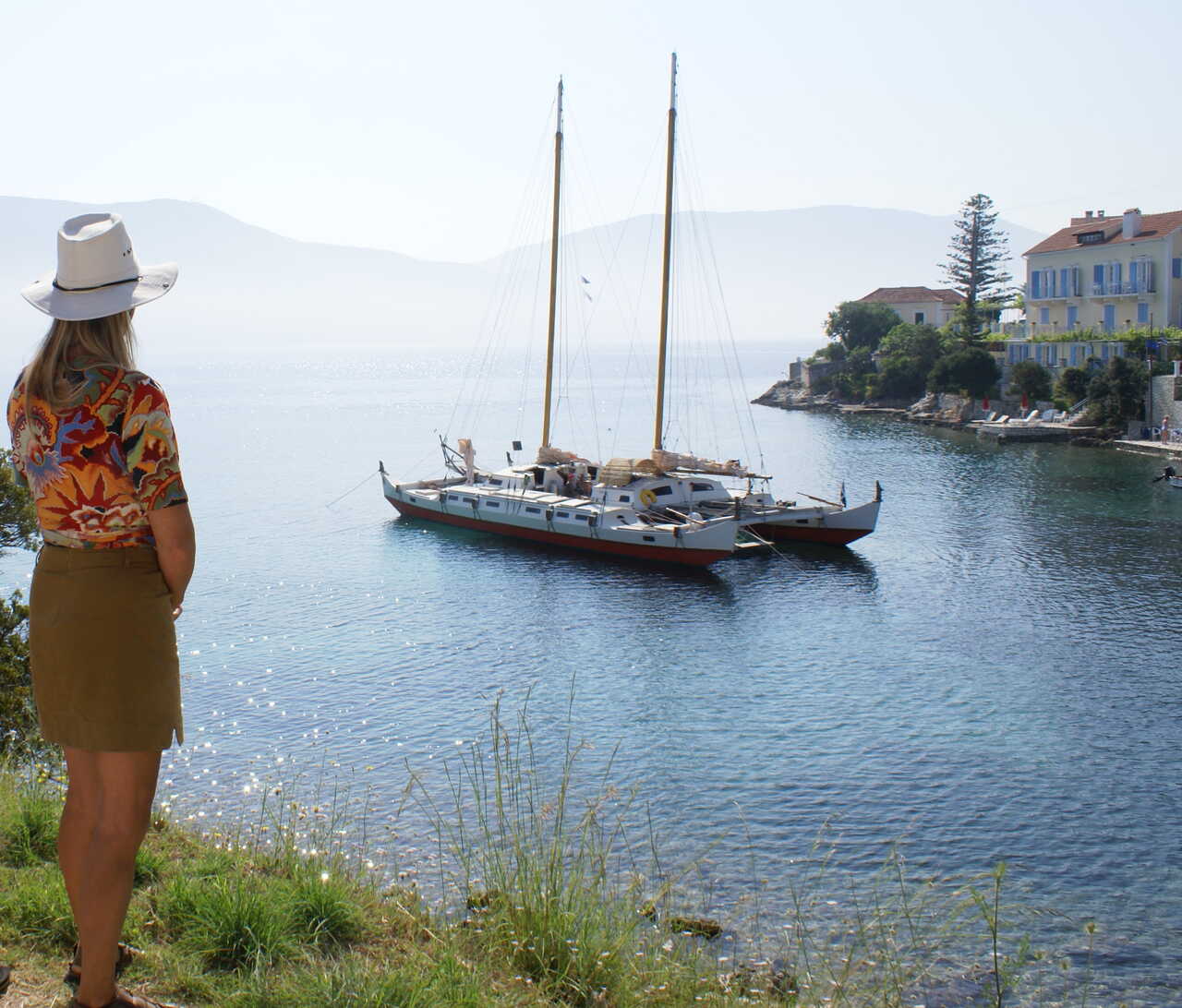
In my designs, I have always used historic canoe-form beam to length ratios of about 12:1. Hulls like this can under good conditions achieve average speeds of around 1.6 x √WLL and top speeds of 2.5 x √WLL, without the need for extreme sail areas that would compromise their form stability. In 1987, I designed my present around-the-world 63-foot catamaran Spirit of Gaia. Her √WLL is 7.2. On this double canoe I used a finer beam length ratio of 16:1. These hulls can achieve and sustain speeds of 10 to 12 knots with ease (approx. 1.5 x √WLL), with relatively small sail area.
In her first years, her testing area was the Canary Islands’ wind acceleration zones, particularly in the strong summer winds. She achieved sustained speeds of 16 to 18 knots (2.2 – 2.5 × √WLL), but at a price. Her whole decks were covered in fine spray; to operate her like this in a cold climate, we would have needed dry suits, as on the recent Americas Cup racing cats.
Final Thoughts
My conclusion is that the slimmer the hulls the less sail area is required to achieve good speeds, thereby increasing stability; but they optimum hull length to beam ratio is about 12:1 as designs of mine with these hulls have achieved speeds as good as those of my 16:1 hulled Pahi 63.
Finally, windage. Many years ago I did some profile windage comparisons. Henry VllI’s and Spanish Armada ships had a length-to-freeboard ratio of 5:1 (20 percent). They could not sail to windward. In the following centuries, sailing ship windage decreased to length-to-freeboard heights of as low as 12:1 (8 percent) in the fast clipper ships. Since the 1990s, cruising multihull freeboards have crept up and up and are now at 20 percent with some even higher with multi-story accommodations, No wonder they have difficulty sailing to windward. I have always kept my designs at an average freeboard height of 12 percent.
Note added in 2025: Freeboards have crept up even further, with many of the popular charter cats having a length-to-freeboard ratio of 3.6:1 (27 percent).
James Wharram has designed dozens of innovative cruising and racing catamarans that have their designs deeply rooted in the long traditions of the sea combined with modern thinking and materials.
